Rongsheng Refractories Group
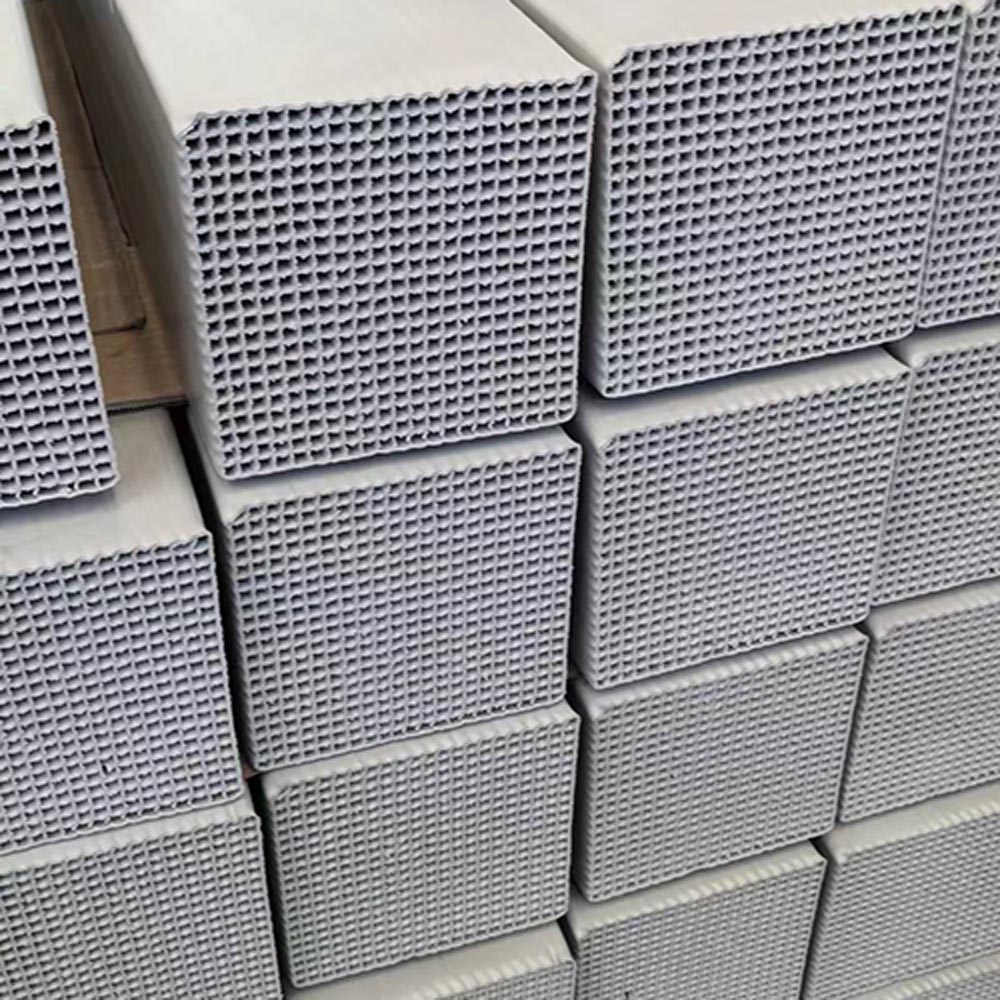
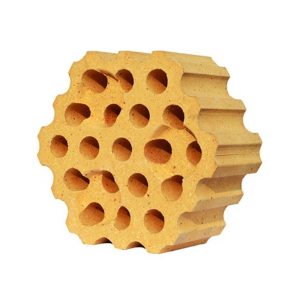
Honeycomb Selective Catalytic Reduction Catalyst – it is a type of emissions control technology, used in diesel engines to reduce nitrogen oxide emissions (NOx) by converting them into nitrogen and water vapor. It consists of a honeycomb-shaped structure, made of ceramic or metal material, coated with catalyst, usually consisting of vanadium, tungsten and titanium.
Parameter of Honeycomb Selective Catalytic Reduction Catalyst
(1)Catalyst for energy industry
| Main cast: | V2O5/WO3/TiO2 | No hole: | 16~25 |
| Application temperature: | 300~420℃ | Denitration efficiency: | ≥90% |
| Ammonia release rate: | <3ppm | SO2 conversion rate: | <0.75% |
| Chemical life: | >24000h | Mechanical life: | >10 years |
| Thanks to its uniform texture, high activity, high efficiency, Low conversion rate and low activity decay, denitration efficiency meets industry requirements. | |||
Index
| Number of holes | 16 | 17 | 18 | 19 | 20 | 21 | 22 | 23 | 24 | 25 |
| Pitch/mm | 9.2 | 8.65 | 8.27 | 7.75 | 7.42 | 7.05 | 6.75 | 6.4 | 6.15 | 5.9 |
| Hole diameter/mm | 8.1 | 7.5 | 7.27 | 6.75 | 6.52 | 6.2 | 5.92 | 5.55 | 5.3 | 5.1 |
| Inner diameter/mm | 1.1 | 1.15 | 1 | 1 | 0.9 | 0.85 | 0.83 | 0.85 | 0.85 | 0.8 |
| Specific surface area, m2/m3 | 368 | 385 | 418 | 433 | 463 | 486 | 509 | 521 | 542 | 566 |
| Opening speed/% | 74.65 | 72.25 | 76.11 | 73.10 | 75.57 | 75.34 | 75.39 | 72.42 | 71.91 | 72.25 |
(2)Catalyst for cement industry
| Main cast: | V2O5(MoO3)/TiO2 | No hole: | 8~13 |
| Application temperature: | 180~300℃ | Denitration efficiency: | ≥90% |
| Ammonia release rate: | <5ppm | SO2 conversion rate: | <0.75% |
| Small volume, high activity, low decay rate; Resistance to sulfur and alkali metal poisoning | |||
Index
| Number of holes | 8 | 9 | 10 | 11 | 12 | 13 |
| Pitch/mm | 18.4 | 16.4 | 14.8 | 13.4 | 12.3 | 11.2 |
| Hole diameter/mm | 16.5 | 14.6 | 13.3 | 11.95 | 10.9 | 9.85 |
| Inner diameter/mm | 1.9 | 1.8 | 1.5 | 1.45 | 1.4 | 1.35 |
| Specific surface area, m2/m3 | 187 | 210 | 236 | 257 | 279 | 295 |
| Opening speed/% | 77.44 | 76.74 | 78.62 | 76.80 | 76.04 | 72.87 |
(3)Catalyst for waste combustion in energy sector
| Main cast: | V2O5(WO3)/TiO2 | No hole: | 30~60 |
| Application temperature: | 160~300℃ | Denitration efficiency: | ≥90% |
| Ammonia release rate: | <3ppm | / | |
| Low temperature, sulfur resistance, resistance to water and alkali metal poisoning; High denitration efficiency | |||
Index
| Number of holes | 30 | 35 | 40 | 45 | 50 | 60 |
| Pitch/mm | 4.95 | 4.24 | 3.71 | 3.3 | 2.97 | 2.48 |
| Hole diameter/mm | 4.35 | 3.69 | 3.21 | 2.8 | 2.52 | 2.08 |
| Inner diameter/mm | 0.6 | 0.55 | 0.5 | 0.5 | 0.45 | 0.4 |
| Specific surface area, m2/m3 | 696 | 803 | 913 | 1008 | 1120 | 1331 |
| Opening speed/% | 75.69 | 74.13 | 73.27 | 70.56 | 70.56 | 69.22 |
(4)Catalyst for marine industry
| Main cast: | V2O5(WO3)/TiO2 | No hole: | 30~60 |
| Application temperature: | 250~550℃ | Denitration efficiency: | ≥90% |
| Ammonia release rate: | <10ppm | NO2 conversion rate: | ≥80 |
| Suitable for operating conditions of machines with low, medium and high rotation speed, is resistant to sulfur, vibration resistance, high specific surface area and high denitration efficiency | |||
Index
| Number of holes | 30 | 35 | 40 | 45 | 50 | 60 |
| Pitch/mm | 4.95 | 4.24 | 3.71 | 3.3 | 2.97 | 2.48 |
| Hole diameter/mm | 4.35 | 3.69 | 3.21 | 2.8 | 2.52 | 2.08 |
| Inner diameter/mm | 0.6 | 0.55 | 0.5 | 0.5 | 0.45 | 0.4 |
| Specific surface area, m2/m3 | 696 | 803 | 913 | 1008 | 1120 | 1331 |
| Opening speed/% | 75.69 | 74.13 | 73.27 | 70.56 | 70.56 | 69.22 |
Working principle of honeycomb selective catalytic reduction catalyst?
Honeycomb SCR catalyst works by injecting a reducing agent, usually an aqueous solution of urea, into the exhaust gas stream of a diesel engine. The exhaust gases then pass through the cellular structure, coated with catalyst, which reacts with a reducing agent, converting NOx into nitrogen and water vapor. The converted gases are then released into the atmosphere.
Application of Honeycomb Selective Catalytic Reduction Catalyst
Honeycomb SCR catalysts are highly effective in reducing NOx emissions and are widely used in heavy duty diesel engines, such as trucks, buses and SUVs. They are also used in power plants and industrial processes, where NOx emissions need to be controlled.
What factors influence the efficiency of honeycomb SCR catalysts?
The effectiveness of honeycomb SCR catalysts may be influenced by the following factors:, how's the temperature, catalyst poisoning and catalyst degradation. Regular maintenance and catalyst replacement may be required to maintain their effectiveness..