 Rongsheng Refractories Group
Comparison between fireproof clay bricks and ordinary bricks
Fireproof Clay Brick – This is a special brick with excellent heat resistance, which is widely used in high temperature industrial equipment. While ordinary brick is usually a common building material for construction and interior decoration. Below is a description of their differences.
Difference between fireproof clay brick and ordinary clay brick

The ingredients are different
Fireproof Clay Brick: The main components are kaolin and other refractory materials, and the kaolin content is relatively high, usually reaching more 50%.
Ordinary clay brick: the main components are ordinary clay and other materials, and it is not particularly fire resistant.
Application range varies
Fireproof Clay Brick: suitable for fireproof buildings, such as high temperature industrial ovens, chimneys, etc., which can withstand high temperatures and chemical corrosion in the environment.
Ordinary clay brick: Suitable for general construction and interior decoration, such as the walls of houses, sidewalk paving, fences, etc..
The production process is different
Fireproof Clay Brick: High quality fireproof materials are used, such as kaolin, which are fired at high temperatures to ensure stable refractory properties.
Ordinary clay brick: It's relatively easy to make, using ordinary clay and other auxiliary materials, and is usually fired at a lower temperature.
Advantages and disadvantages of ordinary clay bricks and refractory clay bricks
Characteristics of Fire Clay Brick
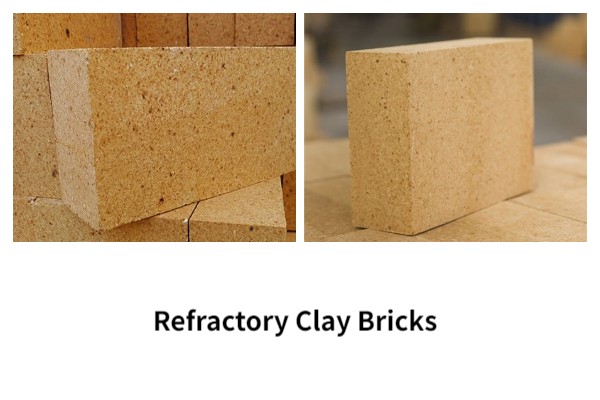
Advantages: It has extremely high fire resistance, can be used for long periods of time at high temperatures and is highly resistant to chemical corrosion.
Flaws: high cost, complex production process, limited scope and cannot be used at room temperature.
Ordinary clay brick
Advantages: The production process is simple, the cost is relatively low, the scope of application is wide, and it can be used at room temperature.
Flaws: not fire resistant, Can't be used in high temperature and flame retardant environment, easy to deform or break at higher temperature.