 Rongsheng Refractories Group
Melting blast furnace and refractories
Blast furnace – This is a traditional combustion device, used to heat metal or other substances. Its basic principle is to obtain high-temperature thermal energy by introducing a large amount of air into the combustion chamber, to make the flame burn more intensely. Blast furnaces are widely used in rough copper smelting process, lead, lead-zinc alloys, antimony and other metals.
Blast furnace design
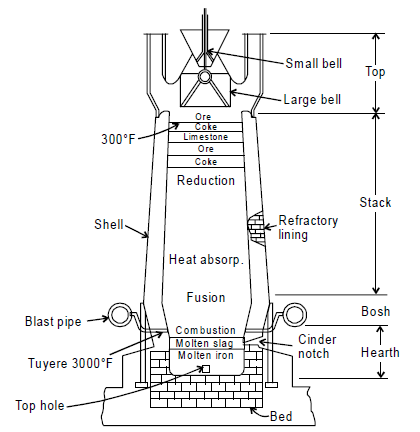
A blast furnace consists of a furnace roof, furnace body, base layer (also called neck), the floor, tuyere device and so on.
Upper part of the oven
Roof – this is the top part of the blast furnace, also known as roof. This is a sealed design, used to cover the top of the furnace body to maintain high temperatures in the furnace and effectively control the combustion process. On the roof of the oven there are usually several combustion openings or loading openings for feeding or unloading food into the oven.
Furnace body
Furnace shaft – this is the basic cylindrical structure of a blast furnace, which is a container for charge and fuel and provides the smelting process. The furnace body is usually made of fire bricks or refractory materials to maintain structural stability at high temperatures. There is usually a slag outlet at the bottom of the furnace body., designed for waste slag removal, formed in the oven.
Tuyere level or bosh
Layer – this is the lower conical part of the blast furnace, also known as under. Ore in the process of smelting, coke and other fuels are fed into the bed through the furnace roof. Melting reactions begin to occur in this layer, and the resulting hot gases and liquid metal rise to the upper part of the furnace shaft.
Blast furnace hearth
Podina – this is another common name for a layer, which represents the area, directly related to the smelting reaction in the blast furnace. High temperature gas in the forge, coke-burning, reacts with iron ore, turning iron ore into liquid iron, while the waste slag forms foam and floats on the surface of the molten iron.
Tuyere system
The tuyere device is an important part of the blast furnace. It is used to supply high pressure air (usually stove air) to the bottom of the furnace to control and maintain the oxygen supply, necessary for the melting reaction in this layer. Typically there are several tuyeres around the perimeter of a blast furnace., which are connected to high pressure fans and air ducts. By adjusting the tuyere position and air flow, The operator can accurately control the temperature and reaction process in the furnace.

How does a blast furnace work??
Hard materials, such as smelting charge (concentrate, sintered ore, etc.), coke, flux and return materials, added from the top of the oven, and high pressure air, injected into the tuyere device from the bottom of the furnace body, is in the process of submission. materials that rise up and fall down undergo such reactions, like melting, oxidation and reduction, to complete the smelting process. Liquid metal, matte and slag are removed from the neck or hearth at the bottom of the furnace, and flue gases, smoke dust, gaseous metals or metal oxides are removed from the flue gas outlet at the top of the furnace.
What refractory materials are used in blast furnaces??
Nowadays most of them are closed furnace roofs, and the furnace body is a complete water jacket. Fireproof materials are used only in the neck and heart, because the slag is an alkaline slag, therefore the neck part is mainly made of magnesia bricks, magnesia-chrome bricks and aluminum-chrome bricks; the upper part is made of magnesia bricks, magnesia-chrome bricks and aluminum-chrome bricks; the lower part of the stove is built into a reverse arch