 Rongsheng Refractories Group
Types and characteristics of waste incineration plants
Incinerators – It is a kind of solid waste processing equipment. At high temperatures, garbage turns into ash and smoke, thereby reducing the volume of garbage and removing harmful substances. Below are several common types of waste incinerators.
Five types of waste incinerators
Grate-type waste incinerator

The grate type incinerator operates continuously and can process more than 200 tons of waste per day. It is equipped with a grate at the bottom of the oven, and waste is fed through the upper hopper. Waste, to be burned, placed on the oven grate, and combustion air is supplied from the bottom of the oven for drying and direct combustion. When using a grate-type incinerator for waste disposal, as a rule, no need to sort or crush waste, except for large items. The surface temperature of the waste layer can reach 800°C, and the flue gas temperature range is from 2800 up to 1000°C. The incinerator has only one combustion chamber, which ensures reliable combustion, good use of residual heat, stable combustion performance and high burnout rate. Solid waste remains in the oven for approximately 1 to 3 hours, while the gases remain for only a few seconds. This type of incinerator is tall and thin, with large volume. This requires advanced operating practices, costs more, and the grating must withstand high temperatures and corrosion and have good mechanical properties, otherwise it may be susceptible to damage.
CAO combustion system (controlled air oxidation)
CAO combustion system (controlled air oxidation) – This is a new type of waste incineration plant with a capacity of up to 150 tons per day. Its key features include a two-step process: First, the waste undergoes thermal oxidative decomposition, followed by gasification and combustion. This results in stable combustion with high burnout efficiency. However, the combustion process is slow and requires precise control of oxygen levels and oven temperature. If the waste has a high moisture content and is not ignitable with oil, stable combustion may not be achieved. The system consists of two combustion chambers: solid waste remains in the first chamber (at a temperature of 600-800°C) by about 3-6 hours, while gases pass through the second chamber (at a temperature of 800-1000°C) by about 1-3 seconds, driven by a propeller.
Fluid bed incinerator
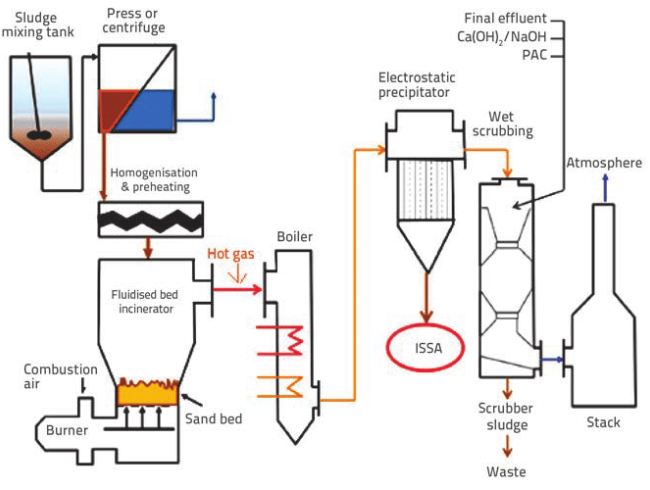
The fluidized bed combustion furnace consists of porous distribution plates. A large amount of quartz sand is added to the furnace, heated to more than 600°C, and hot air is supplied from below (above 200°C), causing the sand to boil. Then the waste is loaded. Waste boils along with hot sand, dry quickly, ignite and burn. Before sending to the oven, waste must be sorted and crushed (10-30 cm). Inside the oven they undergo suspended combustion. This highly efficient process results in thorough combustion. However, the capacity of waste incineration plants is limited and amounts to less than 150 tons per day. The temperature inside the oven is uniform, and the burning rate is relatively high. Solid waste remains in the oven for 1-2 hours, while the gases remain in the oven for only a few seconds.
Installation for incineration of industrial waste in a rotary kiln
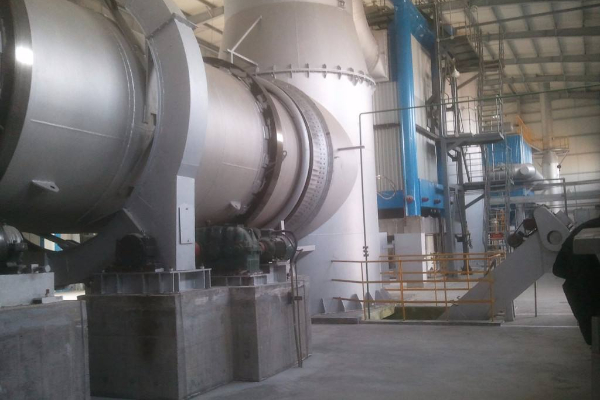
The rotary kiln incinerator consists of a rotary kiln, waste feeding devices, secondary combustion chambers and burners and is equipped with a grate at the rear of the furnace for secondary combustion. This type of rotary kiln is suitable for processing bulky waste and industrial waste (such as sludge, leftover paint, plastics, etc.) without the need for preliminary classification or crushing of waste. The installation productivity is more than 200 tons per day. Solid waste remains in the rotary kiln for 2-4 hours at approximately 900°C. The temperature in the rear combustion chamber is between 1000-1200°C. Ash particles, formed after combustion, small, and the burnout efficiency is relatively high.
Characteristics of four types of waste incineration plants
From the above four types of waste incineration plants, it can be noted, that conventional incinerators typically operate at relatively low combustion temperatures, usually below 1000°C. As a result, some flammable materials may not burn completely.. Hazardous waste components, like those, contained in medical waste, are not carefully processed, which can negatively impact the quality of local soil and water, leading to secondary environmental pollution. Besides, Low temperature combustion can produce dioxins, harmful to the environment, and for human health. To ensure comprehensive combustion and achieve zero dioxin emissions, many advanced technologies have been used in solid waste treatment since the 1980s. These include ultrasonic methods, gasification-melting methods, fuel approaches, obtained from waste, and photochemical oxidation technologies.
Plasma gasifier
Compared to traditional combustion methods, Plasma technology ionizes air, reaching temperatures from 3000°C to 10000°C in a fraction of a second. Such high temperatures lead to rapid decomposition of toxic substances, preventing the formation of dioxins. Hazardous gases and heavy metals are neutralized after treatment in a plasma oven. When feeding waste into a plasma gasification furnace, organic waste undergoes rapid dehydration, pyrolysis and decomposition, resulting in the formation of a mixture of flammable gases, consisting mainly of H2, CO and some organic gases. It is then subjected to secondary combustion to achieve recovery and harmlessness. Inorganic materials (such as metals, glass, etc.) melt under the influence of high temperature plasma, achieving recovery. Compared to traditional combustion, Plasma technology enables more thorough treatment of hazardous waste, forming a crystalline residue, which is not hazardous and can be used in building materials without the need for landfill. Thanks to this process, the volume of waste is significantly reduced, toxic substances are broken down, and the ash from combustion forms glass slag, turning into harmless material. Plasma technology for hazardous waste is a trend in hazardous waste treatment.
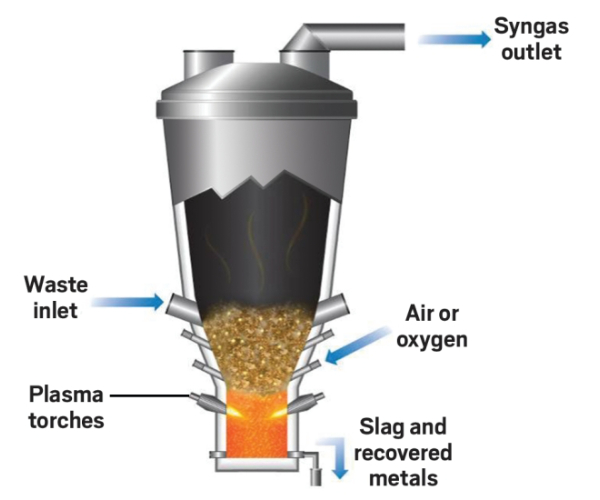
The operating temperature range of the plasma gasification furnace is from 1200°C to 1700°C, the temperature near the plasma torch reaches 1700°C. This instantaneous high temperature places high demands on the thermal resistance of the refractory material.. This process involves intense thermal radiation, causing rapid heating of the surface of the refractory material, which leads to significant temperature differences and thermal stress. Besides, Gasification of waste produces a large amount of water vapor, which, rising, can severely corrode the refractory material in the upper lining of the furnace.